Silly Girl Running vs. 'NO', 'You can't', and 'Girls don't do that'. Because I do. And mess up race photos while I'm at it.
12/19/2011
Peee-ace bunny Galore - How to mess up race photos with your pants down
6/27/2011
It's not me. It's them. The cows.

Aaahhhh. Trails. :)
Hello, cowie! :)
Hat not backwards. Little less geeky.
Trails. :)
Hello, cowie! :) I'm not obsessed. Nope. Perfectly normal behavior.6/24/2011
6/23/2011
Three Things Thursday and a bonus
6/22/2011
Apparently it's just a matter of stuffing yourself like a turkey
Old Leggio
First, the legs. According to my Sports Doc the bone scan is inconclusive - for now. She explained to me that a hot spot isn't necessarily a stress fracture. Especially not when there aren't any other syptoms (mine showed up by surprise on a 'no pain here' leg). Apparently hot spots can appear right after a long long long run (I did a 40K 2 days before the scan) and are a sign of normal bone remodelling.
Hello McFlurry
Second, food. And lots of it. The Sports Doc wants me to see a sports dietician. I'm the last person to call myself skinny, but she thinks my fat percentage is low-ish and my physique is quite skinny. Hmmmpfffff. And she wants me to be sure that I'm getting all the fuel my body needs. I figured 'I eat a lot, and lots of veggies', so I'm fine. Yeah, apparently that's not enough. The sports dietician has some kind of percentage-chart to work out my diet. I'm scared. ;) That she tells me to stop drinking alcohol and stop eating chocolate cake, that is. ;)
Plus, the Sports Doc wants to figure out whether or not I'm okay on my calorie-intake. I'm at 2500-2700 a day, I guess. She says 'at least 3500 for long distance runners'. Uhm...sounds like a lot to me! She didn't applaud my suggestion to add ice cream and cupcakes to my diet. Bummer! ;)
So, like any sane girl would do, I spent the night on Google. :) And found this:
"Inadequate nutritional intake is more common in female athletes than in their male counterparts. Proper diet is paramount for active individuals to maintain adequate energy during physical activity and for postactivity recovery."
[source]
and this:
"Component Summary
Dietary components include macronutrients (carbohydrates, protein, and fat) and micronutrients (fluids, electrolytes, vitamins, and minerals). Specific requirements are presented in the Table in the Summary of Nutritional Requirements and Sources section.
Macronutrients
Carbohydrates
Carbohydrates are necessary to meet energy needs, more so in endurance athletes than in strength athletes.
Carbohydrate needs are commonly based on the athlete's body size and activity level. Individuals engaged in moderate-duration, low-intensity exercise require 5-7 g of carbohydrates per kilogram of body weight. By contrast, those participating in long-duration and high-intensity exercise require 7-12 g of carbohydrates per kilogram of body weight (see the Table).
Fruit, vegetables, brown rice, enriched whole-grain breads, whole grain cereals, rolled oats, beans, legumes, and sweet potatoes are good examples of healthy carbohydrate foods.
Protein
Active individuals have a heightened protein requirement because they have a high percentage of lean muscle mass to support, they need protein to repair muscle tissue that is damaged during exercise, and they require additional protein for energy during exercise.
The amount of protein required depends on the type of activity being performed. Researchers recommend protein intakes of 1.2-1.4 g/kg/d for individuals participating in endurance sports and 1.6-1.8 g/kg/d for those involved in anaerobic activities (see the Table).
Benefits of substituting carbohydrates with protein include the following:
•Enhanced weight loss
•Reduction in truncal adipose tissue
•Optimal maintenance of blood glucose levels
•Improved lipid profile
Protein-rich foods include lean pork and beef, poultry, fish, eggs, beans, tofu, and low-fat dairy products. Women at risk for having a low protein intake are those who restrict their energy intake to achieve weight loss or those who eat a vegetarian diet.
In the past, some investigators expressed concerns that a high-protein diet can cause renal damage. However, no conclusive evidence suggests that a high-protein diet negatively affects healthy adults with normal renal function. In addition, some researchers have raised questions about whether a high-protein or low-carbohydrate diet may increase the all-cause mortality risk in women. Further research is necessary to determine if this is the case.
Fat
Fat provides essential elements for the cell membranes and is essential for the absorption of fat-soluble vitamins. Fat should account for 25-30% of a person's energy intake. Diets should be limited in saturated and trans-fats, while providing adequate amounts of essential fatty acids (linoleic and alpha-linoleic acid). In women, the following intakes are advised (see the Table):
•Linoleic acid intake 11-12 g/d
•Alpha-linoleic acid intake 1.1 g/d
Functions of essential fatty acids include regulation of blood clotting, blood pressure, heart rate, and immune responses.
Dietary fatty acids should come from naturally lean protein foods, nuts, seeds, nut butter, fatty fish (eg, salmon, trout), fish-oil supplements, flaxseed oil, safflower oil, canola oil, sunflower oil, corn oil, avocados, and egg yolks. Women should avoid consuming fats found in processed foods because of their highly saturated nature.
Low-fat diets are not recommended for active individuals. Low-fat diets decrease energy and nutrient intake, reduce exercise performance, and decrease oxidation of body fat stores. Fat provides the most energy per gram of all the macronutrients and can help in achieving a positive energy balance. Dietary fat maintains concentrations of sex hormones and may prevent menstrual disturbances.
Micronutrients
Fluids and electrolytes
Dehydration impairs performance; therefore, athletes must remain well hydrated. Adequate fluid intake is approximately 2.2 L/d for women aged 19-30 years, and increased drinking is required for active individuals or those in hot environments (see the Table).
Athletes should consume 400-600 mL of fluid 2 hours before exercising. During exercise, 150-350 mL (6-12 fluid ounces [fl oz]) should be ingested every 15-20 minutes. For exercise lasting longer than 1 hour or occurring in hot environments, the fluid should be a drink containing carbohydrates and electrolytes.[6] Postexercise meals should include fluids and foods containing sodium, because diuresis occurs with the ingestion of plain water.
Vitamins and minerals
Female athletes are at increased risk for iron, calcium, vitamin B, and zinc deficiencies. These nutrients are vital for building bone and muscle and for energy production. Vegetarians are particularly at risk for developing deficiencies in these vitamins and minerals.
Iron insufficiency is one of the most prevalent nutritional deficiencies among the female athlete because of menstrual losses (see the Table). Iron deficiency may lead to fatigue. Ferritin values are commonly used to reflect iron stores; however, their reliability in the female athlete is questioned.
Excessive iron ingestion may also cause problems, including gastrointestinal distress, constipation, and iron toxicity."
[source]
and this (this is the last one: promise):
"Energy Needs
Total daily energy expenditure (TEE, TDEE)
A female athlete's TEE is calculated by using the following equation:
TEE = REE X PAL + TEA
where REE is the resting energy expenditure, PAL is the physical activity level, and TEA is the thermal effect of activity. Various means exist to estimate REE, PAL, and TEA.
Resting energy expenditure (REE)
Calculations of REE that are conducted in a laboratory by means of indirect calorimetry are the most accurate.
An alternative is the use of equations that incorporate anthropometric variables. The Harris-Benedict equation is most commonly applied to athletes. This equation is as follows:
REE = 655 + (9.5 X weight) + (1.9 X height) – (4.7 X age)
where REE is given in kilocalories (kcal) per day, weight is in kilograms (kg), height is in centimeters (cm), and age is in years (y).
Physical activity level
The PAL value can be determined by using accelerometers, heart-rate monitors, activity diaries, or self-reported activity estimates. Depending on their occupation and daily activities, female athletes may be considered to be moderately to extremely active (ie, have PALs of 1.6-2.5).
Thermal effect of activity
The TEA is calculated as follows:
TEA = weight X duration X METs
where TEA is expressed in kcal, weight is in kg, duration is in hours (h), and METs are the metabolic equivalents of the task being performed, in kcal/kg/h.
METs are found by consulting the Compendium of Physical Activities — a coding scheme developed by Ainsworth et al that classifies specific physical activity by rate — and are determined by dividing the metabolic rate during activity by the metabolic rate at rest. A MET value of 1 is defined as 1 kcal/kg/h, which is approximately the energy expended when a person is sitting quietly. Different physical activities are associated with different MET values. For example, weight lifting is equal to 6.0-8.0 METs."
[source]
Heck of a lot of info, but it IS quite interesting. Lot of it is a no-brainer actually, but there is some info in there that I did not know of. Worth reading for every recreational female athlete/runner, in my opinion. For what that's worth. ;)
Guys, stop reading
Third, my 'baby machine'. Any guys out there reading this? You might want to stop reading now. As in, NOW! If you don't, and think I'm a freak after this, I did warn you!
What the Sports Doc also told me (the Redhead will understand!) is to stop taking my birth control pill for the time being. Why? Not because she wants me walking around with a huge pregnant belly. Nope. She wants to see if the baby machine will still work without the birth control pill (have been taking it since I was 16 - because I had awful migraines). There are no signs that it wouldn't work (that's what she said), but she still wants to rule out any signs of amenorrhea. Better safe than sorry. I kind of like her 'better safe than sorry' kind of approach.
So, that's the story. For now. I'll just take this thing by the day. :) Please feel free to share any thought on nutrition, etcetera!
6/15/2011
Wordless Wednesday - The Naked Truth

6/14/2011
Things I don't get & Lessons learned
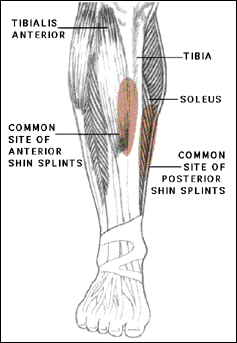
My left shin (shin splints) feels 100% better. Yay. That I DO get.
What I do NOT get. The right shin, that apparently has a SF in it, still doesn't hurt (knock on wood). No pain when touching it. No bump on the shin. Even my Sports' MD and Sports' PT don't get it. At least, when you actually feel pain, you know when it's getting better. I don't. Not at all. And it's frustrating and makes me scared to even try running when I'm allowed to again. What if the shin snaps out of the effing blue when coming down a mountain?
Lessons learned (on this weekend's cycling sessions):
1. Cycling 32 miles a day - coming from a 3 mile base - will make your lady parts hurt. Enough said.
2. Cycling is fun. Seriously. :)
3. It doesn't really matter whether you're running in a skirt or cycling in a pink cycling jersey, the honking continues. That is, when on a bike, the honking actually scares the shit out of me! At one point I actually figured I must have been on the wrong side of the road or something.
4. Uphills will make your quads hate you.
5. A GPS on your bike is a godsend. No kidding. Especially with my navigation skills.
6. Wearing a helmet for 2 hours straight will give you helmet hair. Please check mirror before rushing out the door to meet a friend for drinks...
7. Moeben arm sleeves work as great on a bike as they do on a run.
8. Cycling is actually fun. Oh, I already said that? ;)
6/13/2011
Confessions of an injured runner: I'm a wimp
However, I carefully avoided all the 'might be slippery' bits of the road today. Why? Because I'm a wimp. I'm afraid I'll crash and break something all the time (then again, apparently I don't need to actually crash to break something...). Okay...and it might have something to do with me spending several hours on YouTube last night, searching for 'how not to crash on a bicycle'. Guess what came up in the results? Correct, lots and lots of clips of crashes. After watching this one, I'm ready to wrap myself in bubble wrap.... That wouldn't be weird, right? Right?
Any advice on this one? ;) (And nope 'stop spending several hours on YouTube' won't help. ;))
6/10/2011
Leave me the bottle

6/01/2011
May Recap / Stats
Rest days planned / taken: 10 / 11 - Took an extra rest day after the Edinburgh Marathon
Highest mileage / km week: 9/5 - 15/5 : 50.1 miles / 80.2 km
Long runs planned / ran: 4 / 6
Pace / speed work outs planned / ran: 3 / 3 (Because a marathon still counts as a pace work out in my book....)
Cross training work outs planned / done: 6 / 6
Donuts burned: 102.5
Current shame-inducing guilty pleasure: Drinking way too many Starbucks Chocolate (skimmed milk ;)) Frappucinos. It's calcium, right? Need calcium for the ol' bones. :)
Current obsession: Stalking Google: need all the info on lower leg problems and stress fractures. :(
Current drink: Still fennel tea, water and diet coke. And Gatorade. Still boring.
Current song: P Diddy - Coming home.
Current need: Sleep. And my body to stay on track. Bloody shin.
Current triumph: Getting 20 minutes of my marathon PR within 51 days. I heart Edinburgh Marathon. :)
Current bane of my existence: My left lower leg: shin. And being scared sh#t of what the outcome of the bone scan will be. Enough said.
Current blessings: A perfect marathon at the Edinburgh Marathon on May 22nd.
Current excitement: New 3:50:33 marathon PR. Enough said. :)
5/31/2011
*Crack* - The Injury Blues revisited
No. No. No. :(The pain is located on my shin (anterior side) and the spot is about the size of a chocolate chip cookie (my comfort food, get over it.). There's a dull pain when I run on it. And there's a dull pain when I jump on it. Walking, walking stairs, etcetera is pain free. Even tapping - and slamming - on the shin doesn't hurt. Yeah...'weird bones', that's what my GP calls them.
5/03/2011
And I thought I'd need a head doctor...
Lesson learned: threat your feet well. Especially when you're a runner! I never did and will have to pay for that...
Why? Well, after my brilliant plan to run 2 marathons in 2 weeks (it was a fantastic plan! And I had so much fun!) my right pinky toe turned against me. It did. It's a bit better now. Plus, I was able to run. Barefoot or in Newtons (large toebox), but it didn't keep me from running.
Warning: Gross photos coming up!
That cute little pinky toe still looks gross, but if feels a heck of a lot less painful than a couple of days ago. And guess what? I might not lose the toenail. Check!
And, uhm, did you spot the conveniently placed blister on the other toe? Yeah...sexy feet. Sexy feet...
'Big toe' is a scientific term
Halfway in my left 'big' toe (that's a scientific term, I'm sure) started to hurt. When I returned home I took off my socks and figured I was dealing with a black/bruised toenail. The fluid underneath the toenail - due to the 'black' thing going on there - was causing some pressure. Applied Arnyca gel (yeah, I throw that stuff on about anything), iced the heck out of it, and rested it. Today (Tuesday) the black toenail thing is already less painful. A lot less painful. See, Arnyca works. ;)
However, when I woke up yesterday morning (Monday) it felt like The Black Big Toe had an ingrown toenail. Could this happen overnight? Tried to fix it with a pair of tweezers and scissors. Didn't work. Drowned the thing in Calendula gel to keep it clean. Phoned the GP and was called in to see her this morning. To remove part of the toenail. Something I was really looking forward to. NOT!
At the GP's - this morning - she told me she was not going to remove anything yet (oh yeah, I love the 'yet' part...ouch). Apparently the toenail is about to become an ingrown toenail, but not quite there yet. With the marathons and ultra bonanza planned and coming up (hopefully), she wanted me to go see a Podiatrist as soon as possible. She released some of the pressure by taping the toe. So, made an appointment with the Podiatrist and was told that the Podiatrist will put something (not sure what) underneath the toenail to prevent the nail from growing in. Oh, and this will be painful (not only the procedure itself, but in the weeks after that) and will most likely keep me from running for a while. Fingers crossed she's wrong! :(
I can only blame myself - lesson learned
Apparently I'm not the only runner with an (almost) ingrown toenail. The GP told me it's a common thing. Great. Plus, she told me that it could be prevented, at least in most cases, by regularly having a pedicure done. Uhm...I've never ever had a pedi. Never. Ever. The look on the GP's face when I told her that. Lesson learned: spend money on a pedicure.
Oh, wonder what my 'big' toe looks like? Even more gross photos coming up!
There's a bit of a black-ish toenail thing going on there, but nothing too bad.
1. I have extremely long toes. I know. Get over it. 2. See how the toenail is somewhat 'rounded' instead of straight. That's what's causing the 'about to get an ingrown toenail' thing. It's not ingrown yet, but if I don't let the Podiatrist do something about it, well, uhm, NOW, it could get infected. Apparently this could happen to every runner: especially when you're running in higher temps and your feet get sweaty.
3/03/2011
Three Things Thursday
2/10/2011
Three Things Thursday
Photo courtesy of www.runningskirts.com1/23/2011
What he said, what she said
1/14/2011
Runner's remorse
1/12/2011
Flexing it
The Foot. Who could've guessed that this nasty little thing could cause so much pain? I can't even do a single leg raise on my left leg. Gee... Frustrating. I feel completely drained and depressed, and I really don't want to not hold my head high.
Yesterday I saw another MD. For a second opinion on the foot. To sum it up: I did not like the opinion of this second MD. Why?
The MD examined the foot and told me that the joints in my feet are more flexible than they should be in a normal person (okay, bring on the 'you're not a normal person'-jokes! I can take it...). Plus, there's some sort of cyste on my ankle (size of a pearl). Apparently lots of athletes (or semi-athletes like myself: ha!) have 'flexible feet'. I figured 'flexible' was a good thing. Well...guess again. The MD explained to me that this überflexibility could cause early arthritis. I figured that if that's the case I should just rest the foot for now, start building the mileage when it feels okay (for the record: it does NOT feel okay at the moment), and then add more strength training and replace one work out per week with swimming or cycling.
Uhm...nope. The MD wants me to not exercise (besides hiking and some strength training) at all. I repeat: no exercise besides hiking and strength training (no cycling, swimming, etcetera). In her opinion even walking around would be hard when I turn 40, if I don't. What the bleep? For the record: this MD is not involved in some kind of endurance sport herself. Nor did she understand what running means to me. Being silly me, I googled on the subject as soon as I got home, and did not find one article stating what she had told me.
Two days, two MDs, two completely different opinions. I'm clueless.
My sports PT told me to crosstrain for at least a week. And check how The Foot feels after that. And start building the mileage again (slowly) as soon as the foot is OK. I'll just go with her advice for now. After all...she works with athletes every single day.
Guess who's off for a swim tonight? ;) I might even take a few photos of me in my Speedo (or, what I'd like to call, 'the dealbreaker'). ;)
Any bloggers out there with 'flexible feet'?
1/11/2011
Is sucktastic even a word?
So, guess what?
I'll be hitting the bikes again. And the pool. For the time being, that is. Luckily, swimming and cycling are my new-found loves. ;) And my 78K schedule does not start till mid February and happens to have a high run/walk-ratio for the weekend long runs (5+ hours on Saturday's and 5+ hours on Sunday's - Yay!). Plus crosstraining makes your body stronger, right? Right?
Also I asked for a second opinion on my foot. And the possible foot/calf/knee thing. Tonight another MD will examine it. I really really want to know what this MD has to say on the foot-subject.
Oh, as a bonus, later today/tomorrow, I'll post a photo of charming me in my cycling shorts with crotch pad. Uhm, I mean 'chamois'.
Did you ever have some kind of foot injury?
Cycling: 30 min Strength training: 45 min Hill work (16% incline) (walking): 17 min
1/10/2011
And she's out again...The injury blues
12/07/2010
Oh no, you didn't!